Skip to product information
1 of 1

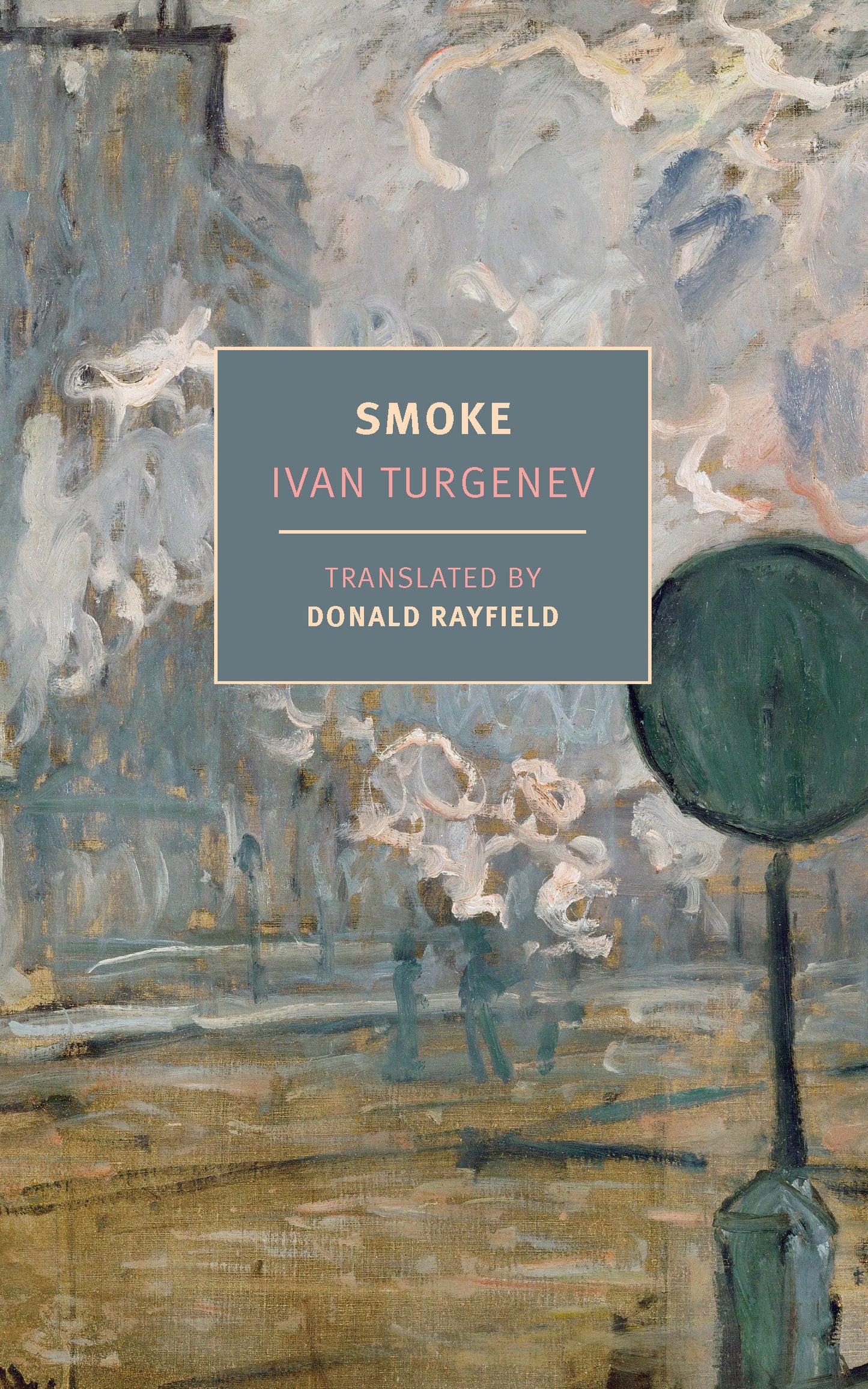
Smoke

Smoke

by Ivan Turgenev, translated from the Russian by Donald Rayfield

Regular price $18.95
Regular price Sale price $18.95
Sign up for our newsletter to be notified when this book and other new titles are available for purchase:

Ivan Turgenev’s fifth novel, Smoke, published in 1867, differed from his previous novels, three of which had revolutionary heroes dying dramatically. His new hero, Grigori Litvinov, the most likeable protagonist in nineteenth-century Russian literature, is an intelligent but unremarkable man who returns from agronomical studies in Germany intending to marry then run his father’s neglected estate. He stops in Baden-Baden to meet his fiancée Tatiana and runs into his former love, the now aristocratic Irina, who is staying there with her husband. A dormant erotic passion overwhelms Litvinov; he jilts Tatiana and prepares to elope with Irina: a fatal mistake, yet Turgenev is merciful to his hero, who in time atones for his temporary insanity, realizing that like Voltaire’s Candide, he can only cultivate his garden.

The Russians abroad in Smoke, whether revolutionaries or reactionaries, emerge as hypocritical bigots. Turgenev’s authorial character Potugin denounces both right-wing aristocrats and left-wing radicals—indeed all of Russia—as irredeemably backward. Reactions were furious: Turgenev was forced to stay abroad. Tolstoy said that he loved only fornication, not his country; the poet Tiutchev that he was polluting “the smoke of the fatherland, sweet and pleasant” (a famous line by the playwright Griboyedov).

Smoke shares much with Gustave Flaubert’s Sentimental Education: the novels were written simultaneously; the authors were close friends, equally disillusioned. Flaubert likewise has an unremarkable hero, torn between two women and two political forces, though his monumental novel is more brutal, comparing a besotted lover to someone bringing a bunch of flowers to a brothel. In his novella Torrents of Spring, Turgenev had already described a vulnerable hero robbed of a fiancée by a ruthless aristocratic woman. Smoke is yet more powerful: readers will feel they have not just read, but experienced Litvinov’s trauma.

Additional Book Information

Series: NYRB Classics
ISBN: 9798896230441
Pages: 272
Publication Date:

Praise

Turgenev was not given to nationalistic romanticism or to giving speeches. He represented what to the modern state remains troublesome: a man who desires neither to lead nor to be followed.
—Hisham Matar, The Guardian

[Ivan Turgenev] was driven by a passionate curiosity about his fellow men, and a gratitude for their endless complexity that ran far deeper than mere judgment. Reading Turgenev provokes the question: Can we learn from him? Can we, too, remove ourselves just enough from our intractable conflicts to find them fascinating, to find them amazing—even to love them?
—Sam Sacks, on Turgenev’s Fathers and Children, The Wall Street Journal

[Ivan Turgenev] faithfully described them all—the talkers, the idealists, the fighters, the cowards, the reactionaries, and the radicals, sometimes, as in Smoke, with biting polemical irony, but, as a rule, so scrupulously, with so much understanding for all the overlapping sides of every question, so much unruffled patience, touched only occasionally with undisguised irony or satire (without sparing his own character and views), that he angered almost everyone at some time.
— Isaiah Berlin, The New York Review of Books

There is nothing in literature more stinging than the satire of the first six chapters of Smoke, which has a quality of Dickens about it. This is not hatred, however. While laughing bitterly at his young "intellectual" countrymen, Turgenev understands them; they, like himself, are creatures of environment and heredity.
—John Reed, from the introduction to the 1919 edition of Smoke

View full details
  • Shopping for someone else but not sure what to give them? Give them the gift of choice with a New York Review Books Gift Card.

    Gift Cards 
  • A membership for yourself or as a gift for a special reader will promise a year of good reading.

    Join NYRB Classics Book Club 
  • Is there a book that you’d like to see back in print, or that you think we should consider for one of our series? Let us know!

    Tell us about it