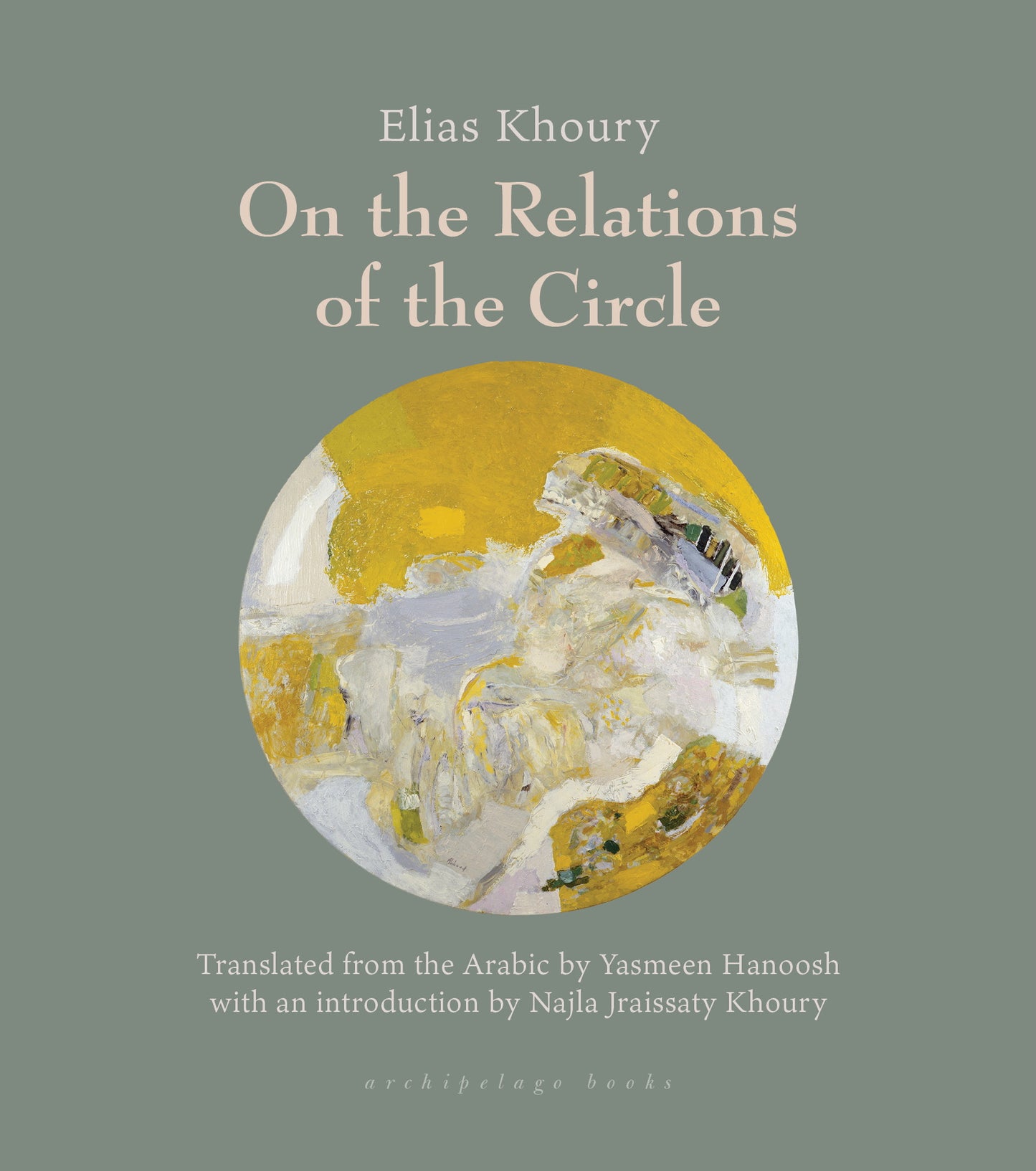
The surrealistic debut novel of the iconic Lebanese novelist . . . Khoury’s style here is highly impressionistic and shape-shifting, as if to echo the sense of dislocation and confusion Mansour experiences . . . Khoury’s sentences are rich with synesthetic imagery . . . [and] vivid passages of the bustle of Beirut . . . The stakes are consistently high, as Mansour travels the city and notes its abundance of graveyards. While other books describe post-Nakba Palestinian protest more plainly, this one evokes the displacement and heartache at its core. An eerie and lyrical vision of statelessness.
—Kirkus Reviews
The salient quality of this wonderful novel is not found in plot summary. Though the story of an orphan in ’70s Beirut is compelling, Khoury’s execution of how a consciousness emerges is brilliant and nearly peerless . . . I’ve only experienced this level of vivid and necessarily linked surreal imagery in Sergei Parajanov’s film The Color of Pomegranates. Just as every frame of that film could be a (powerful) painting, each image you will encounter [in On the Relations of the Circle] can be studied in order to reveal the larger wonder of awakened being.
—The Brooklyn Rail
An exquisite book, like a novel in a funhouse mirror, that reads like direct dictation from dream and nightmare alike. Written in sinuous, startling lines, every page displays Khoury’s signature keenness of perception about history, nation, and the self’s treacherous interior. This book is a crucial reminder that the world drawn askew can be the world drawn most precisely.
—Elisa Gonzalez
What a blessing to still get new Khoury books to read even after he’s gone . . . [On the Relations of the Circle] unfolds like the fragmented memories of childhood, tracing the orphan Mansour through his encounters with his world and surroundings, mystical and material. A gorgeous and poetic tale.
—Samia Saliba, Mizna
Despite Elias Khoury’s known wizardry as one of the great contemporary narrators, his referential bedrock can always be found in the full corpus of Arabic poetry, texts he knew intimately. Yasmeen Hanoosh’s utterly lucid rendering of his first novel finally squares the circle of Khoury’s magnificent achievement. Deeply enmeshed in his own language and culture, he embraced the world fully, with all its pain, suffering, and wonder, while never ceasing to demonstrate that true human dignity emerges from active resistance to all forms of oppression.
—Ammiel Alcalay
Elias Khoury’s first novel, On the Relations of the Circle, exists within its own spacetime. Set on the eve of the Lebanese Civil War, gravity shifts in these pages, and the physics of the work follows that of dreams. Gorgeous and ethereal, this is a must read from a beloved master of Arabic fiction.
—Hannah Lillith Assadi
Elias Khoury, along with Mahmoud Darwish, is an artist giving voice to rooted exiles and trapped refugees, to dissolving boundaries and changing identities, to radical demands and new languages. From this perspective Khoury's work bids Mahfouz an inevitable and yet profoundly respectful farewell.
—Edward Said
Because the world is the way it is, because whole groups of people can be maligned, neglected, ignored, for too many years, we need the voice of Elias Khoury—detailed, exquisite, humane—more than ever. Read him. Without fail, read him.
—Naomi Shihab Nye